
Condemned to Becoming
Toward an Existentialist Process-Relational Theology

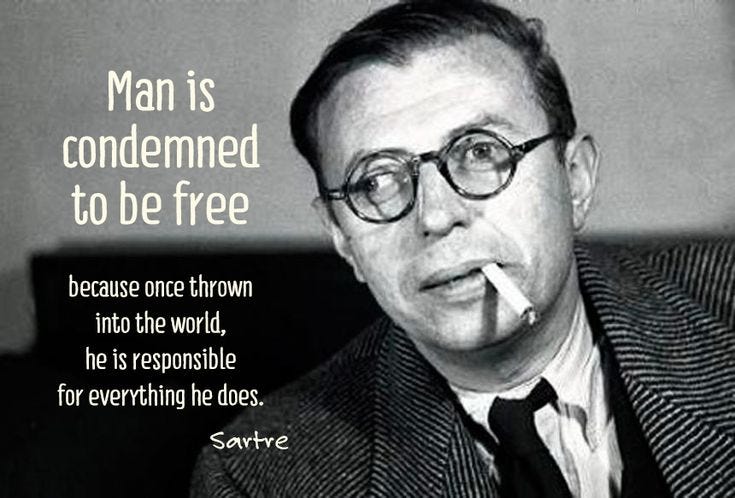
Before you send hateful emails… I am more than aware that Sartre completely rejects the idea of God, and that this is the foundation of his Existentialism. This essay is a playful attempt to bring my favorite things from Sartre to Process Theology. This is a Theology with Existentialist themes, not a “Processing” of Existentialist thought.
INTRODUCTION: TWO PHILOSOPHIES OF BECOMING
Among the various philosophical and theological traditions available to us today, there are two that I constantly find myself coming back to: Existentialism and Process Philosophy. At first glance, the Radical Existentialism of Jean-Paul Sartre and the Process-Relational Metaphysics of Alfred North Whitehead appear to occupy opposite ends of the philosophical spectrum. Sartre famously declared that existence precedes essence, and grounded his philosophy in the absolute freedom and responsibility of the individual human subject. Whitehead, on the other hand, articulated a grand cosmological vision in which every actual entity, from the simplest of particles to the most complex organisms, participate in an ongoing creative advance. Sartre’s universe is one of anguished solitude and radical self-creation, whereas Whitehead’s universe is one of cosmic creativity, relational interdependence, and Divine persuasion.
After sitting with these two thinkers long enough, the obvious tension present between them begins to soften. Both Sartre and Whitehead were deeply anti-essentialists and refused static, substance-based ontologies in favor of process, event, and becoming. Both insisted that freedom is not an optional feature of reality, but is inherent to its very structure. And both have implications for thinking about God in light of the irreducible fact of human self-determination for Sartre, and cosmic self-determination for Whitehead. What might it look like to construct an Existentialist Process-Relational Theology by engaging these two thinkers? What would it look like to take seriously Sartre’s diagnosis of the human condition—our thrownness, or radical freedom, the nausea of groundlessness, the weight of anguish and responsibility—while also embracing Whitehead’s conviction that the human condition is not an exception to the universe, but the sharpest expression of creativity, and an exemplification of it? If God exists in any meaningful way, what kind of God could honor both the radical freedom of Sartre that makes bad faith possible and the creativity of Whitehead that lures all actual entities toward goodness, beauty, truth, adventure, and zest?
SARTRE’S EXISTENTIALISM: FREEDOM WITHOUT GROUND
In Sartre’s existential philosophy, he defines being-in-itself as the dense, complete existence of things that simply are what they are, without any awareness or possibility. On the other hand, being-for-itself describes human consciousness as a self-aware, open, and incomplete mode of being that constantly transcends what it currently is through freedom and possibility. This for-itself is never what it fully is and is always separating itself from what it is and projecting what it is not. This internal lack is what Sartre calls “nothingness” and constitutes the very conditions for freedom, reflection, and possibility. “We are condemned to be free,” Sartre declares, alerting us to the fact that there is no escaping the burden of choice. We cannot appeal to God, nature, human nature, social contexts, or psychological determinism to excuse us from the weight of our decisions. Every attempt to flee from the weight of our freedom is what Sartre called “bad faith.”
The consequences for Theology are devastating, for if God is conceived as the ground of human essence, as the one who determines what human beings fundamentally are before they exist, then God is the enemy of authentic existence. The God of Classical Theism, the God who holds the ideas of all things in the Divine mind and who creates creatures according to an eternal blueprint, is the God Sartre’s existentialism must reject by definition. Such a God would reduce humans to things or objects, rather than self-creating subjects. “If God does not exist, then man is condemned to be free” is not just a logical point, but an existential declaration that authentic human existence necessitates that there are no pre-given essences, no Divine script, and no metaphysical safety nets.
Don’t confuse Sartre’s atheism with something easy or triumphant, however. The death of God burdens us with what Sartre calls the “useless passion” of the for-itself. This is the dreadful and anguished recognition that we desire to be the Being-In-Itself-For-Itself that Classical Theism reserved for God alone. We want to be God, and cannot be. Thus, the human condition is always already burdened with a sort of ontological grief, the longing for a foundation that cannot exist (God) without negating the very freedom that makes us human.
WHITEHEAD’S PROCESS PHILOSOPHY: CREATIVITY, PREHENSION, AND BECOMING
The Magnum opus of Alfred North Whitehead, Process and Reality, is an exercise in what Whitehead calls “speculative philosophy”. Within this work, he attempts to articulate an internally coherent and applicable scheme of ideas capable of interpreting every aspect of experience. Whitehead articulates an event-based ontology in which he calls the basic unit of reality an actual occasion or an actual entity. An actual occasion is a momentary drop of experience that arises, achieves synthesis, and perishes, becoming part of the objectified past that subsequent occasions prehend, or feel with non-sensory/non-conscious perception. The process by which an actual entity comes into being is called concrescence, a growing-together of the inherited information from the past, the possibilities of the future, and the initial aim of the Divine. This aim should not be thought of as a command, but instead as an invitation or a lure toward the best available realization of value given the constraints of the past. All actual entities are genuinely free to accept, modify, or resist the Divine invitation. The result of each concrescence is the achievement of novelty, the self-determination of the entity, and a contribution to the ongoing creative advance.
Whitehead, unlike Sartre, still has room for God in his system, although his conception of God is novel to say the least. For Whitehead, God is a particular type of actual entity consisting of two natures. Within the Primordial Nature, God envisions all eternal objects, making them available as genuine possibilities for every actual occasion. Within the Consequent Nature of God, God prehends every actual occasion as it perishes and preserves its achieved value within the Divine experience forever. This God does not coerce and does not determine outcomes, but instead always persuades by offering aims that creatures are free to actualize or reject. Far from being Omnipotent, the God of Whitehead is Amipotent, in the words of Thomas Jay Oord, and always “acts intentionally, in relational response to creation and past divine experiences, to promote overall well-being.” Said differently, divine power works exclusively through invitation and love and never through unilateral control.
The implications for theodicy are profound, have been widely noted by Process Theologians, and are one of the most attractive aspects of Process thought. For the purposes of this essay however, what matters most is the ontological claim that at every level of reality, there is genuine self-creativity. Each actual entity is not simply the product of its past nor divine determination, but the author of its own concrescence in each moment of becoming. If freedom is the burden of the human condition for Sartre, for Whitehead, freedom is the universal character of becoming itself.
CONVERGENCE: NAUSEA AND THE CREATIVE ADVANCE
The most obvious point of convergence between these two great thinkers is their shared anti-essentialism. Both Sartre and Whitehead are philosophers of becoming who refuse to reduce reality to static substances or pre-determined natures. For Sartre, the for-itself has no essential nature and instead is the ongoing project of making itself what it is not yet. For Whitehead, every actual entity is defined not by passive determination, but by how it actively processes its inheritance of the past and achieves its own synthesis. In both cases, being is secondary to becoming, and existence precedes essence. Beyond the structural analogies, there are a few other points of convergence. Both Sartre and Whitehead are attempting to imagine a world that is genuinely open, genuinely temporal, and genuinely characterized by novelty and emergence. These two thinkers do differ in scope, however. Sartre restricts becoming to human consciousness (the for-itself), while Whitehead universalizes it across all of nature. This difference, perhaps, should not be seen as philosophically fatal but instead as philosophically fertile.
Another point of convergence can be found around the concept of thrownness. Following in the footsteps of Heidegger, Sartre acknowledges that the for-itself is always already thrown into the world. A body, a history, a social location, and a set of factual constraints are all given without choice to the for-itself and must be taken up into its projects. Whitehead articulates the notion of physical prehension, submitting that every actual entity inherits the entirety of the past as the datum of its concrescence. This inheritance is again not chosen, but the difference for Whitehead is that said inheritance is not simply a limitation but also a resource and a gift of determinate reality upon which creativity can work. Sartre experiences thrownness as a burden and nausea; Whitehead experiences throwness as a form of aesthetic value to be both integrated and exceeded.
Perhaps most importantly, both thinkers share a deep suspicion of any conception of God that functions as the sole determiner of meaning and as a cosmic insurance policy against the human condemnation to freedom. Sartre’s rejection of God is motivated by the insight that such a God would undermine authentic self-creation, reducing the Being-For-Itself (the subject) to a Being-In-Itself (an object). Whitehead’s God avoids Sartre’s nightmare as a God who does not determine outcomes unilaterally, does not supply essence, and does not override creaturely freedom. The Whiteheaded God is a God of possibility, a God who offers a range of options within which genuine self-determination occurs, and genuine freedom is preserved.
DIVERGENCE: NAUSEA AND THE DIVINE LURE
In an act of self-preservation, seeking to prevent assault at the hands of my good friend Dr. Taylor Thomas, I would be remiss if I didn’t take the divergences of these two thinkers very seriously. The most obvious point of divergence is that for Sartre, the groundlessness of human existence is anguishing precisely because there is no Divine lure, no initial aims, no cosmic telos inviting the for-itself toward beauty or value. There are no facts of the matter about which projects in life are worth pursuing; instead, the for-itself must create its own values through its projects, fully recognizing the radical contingency of said values. The nausea Sartre famously describes is the visceral recognition of this radical contingency, the recognition that existence is superfluous, excessive, and without necessity or justification.
Whitehead is obviously unable to accept this. For him, the absence of the Divine lure would be catastrophic, leaving actual occasions with no initial aim to respond to, no value to orient their concrescence, and the collapse of the creative advance into pure randomness and chaos. The ordering of infinite possibilities in light of value and offering each actual entity something to respond to (either positively or negatively) is the very function of the Primordial Nature of God. Again, without this function, creativity would not be freedom but chaos. The Existentialist Process-Relational Theology I am attempting to offer must take both sides of this obvious tension seriously. It would be a mistake to dissolve Sartre into Whitehead, sneaking the Divine lure Sartre rejects, in through the back door. It would equally be a mistake to reduce Whitehead to Sartre, abandoning the cosmic dimension of creativity.
Perhaps we can reframe Sartre’s experience of nausea within a Whiteheadian framework, as a sort of ontological honesty that is both ethically and spiritually significant. What if we look at nausea not as the final word about human existence, but as a necessary moment of clarity in which an authentic response to the Divine lure is made possible? (An epistemological post-modernism, not a metaphysical post-modernism, in the words of J. Aaron Simmons) The person who has never experienced nausea, who has never confronted the groundlessness of their existence, is incapable of genuine self-determination because they have never truly recognized and owned the freedom that is the condition of such determination. Bad faith, in Whiteheadian terms, could be seen as the refusal of the initial aim and a flight from the creative advance into the false security that one is simply the product of one’s inheritance.
TOWARD AND EXISTENTIALIST PROCESS-RELATIONAL THEOLOGY
To help move us toward an Existentialist Process-Relational Theology, I would like to offer five potential theses for the readers’ consideration:
Thesis 1: God Does Not Supply Essence but Offers Possibilities
As stated previously, the God of this potential framework is not the God of Classical who holds the essences of all creatures within the Divine mind. That is precisely the God that Whitehead and Sartre rightly reject. The God of an Existentialist Process-Relational Theology would be a God who is the ground of all possibility, the God who makes the entire range of eternal objects available for creatures to actualize. This God does not determine what any creature will be and instead opens a space for Divine co-creation where genuine self-determination is possible. Existence still precedes essence, becoming is still favored over being, but proceeds in a universe that is not indifferent and is instead oriented toward value, beauty, and intensity of experience.
Thesis 2: Freedom is Ontological, Not Merely Human
Sartre is correct in his assessment of human freedom being both radical and inescapable, but within the Whiteheadian framework, freedom is not an anomalous interruption of the natural order but is the sharpest actualization of creativity that belongs to reality as such. Human beings, therefore, are not free despite being a part of nature, but are the very place where nature’s universal creativity achieves its most intense and self-conscious actualization. This would reframe the existentialist categories of authenticity, bad faith, anguish, and projection as more than just descriptions of the human condition. They, in turn, could be seen as diagnoses of how any actual entity can succeed or fail in its own self-determination.
Thesis 3: Anguish As A Spiritual Discipline
The recognition of one’s radical freedom and responsibility, or anguish as Sartre names it, is not a psychological state to be overcome but is a genuine spiritual discipline. In Whiteheadian language, anguish is what happens when an actual entity of sufficient complexity prehends the full weight of its initial aim and recognizes that the outcome of its concrescence is genuinely up to it. To Sartre’s point, this is not a comfortable recognition, but the recognition that makes an authentic response to the Divine lure possible. An Existentialist Process-Relational Theology that attempted to paper over anguish would not only be intellectually dishonest but would be what Sartre would recognize as a religious form of bad faith. For this reason, anguish should be seen as a genuine spiritual discipline.
Thesis 4: God Suffers With and Learns From the World
The God who prehends every actual occasion and preserves its achieved value provides a resource for a theology of Divine solidarity that Sartre’s framework cannot supply, but that his diagnosis of the human condition arguably demands (from a theistic perspective). Sartre’s for-itself is characterized by longing and the useless passion to be the Being-In-Itself-For-Itself, to be God. An Existentialist Process-Relational Theology proposes that this longing is not useless but is a prehension, however distorted, of the Divine reality itself. God is the one actual entity who does achieve, in the consequent nature, something like the synthesis of freedom and being-in-itself that the for-itself futilely desires. God is genuinely affected by the world, integrates creaturely experience into the Divine experience, and thus becomes the “companion” of creaturely becoming.
Thesis 5: Authentic Existence is Theological Co-Creation
The synthesis of Sartre and Whitead offers a distinctive account of what authentic existence looks like. Authentic existence is not simply self-creation in a vacuum, as if the for-itself were creating values ex nihilo in a godless universe. Nor is it the submissive obedience to divine commands that pre-determine what one should do. Instead, it is a genuine response to the Divine lure that is nonetheless entirely one’s own. Within this proposed framework, to exist authentically is to prehend the initial aim, feel the pull of the subjective aim oriented toward value, and to actualize it while fully embracing the weight of one’s genuine freedom. This is not heteronomy but what we might call theonomous autonomy, a freedom that is genuinely one’s own because it is responsive to the deepest grain of reality rather than being reactive to social pressure, habit, or the escape from anguish.
(RE)THINKING BAD FAITH
As noted, Sartre identifies bad faith as the attempt to escape from our condemnation to freedom into the false comfort of essence, the pretense of being a thing, determined and excused from responsibility. Within religious contexts, bad faith typically looks like hiding behind divine commands, ecclesial authority, or the common refrain that one has no choice but to follow God’s will. Sartre was correct in identifying this as a fundamental form of human self-deception.
Whitehead allows us to recognize a second, complementary form of bad faith, the refusal of relationship. This is the pretense of radical self-sufficiency and the denial of the prehensive depths that constitute every actual entity. If Sartre’s bad faith is the escape from freedom into essence, perhaps Whitehead’s bad faith is the escape from relationship into the illusion of the isolated self-creator. The for-itself that imagines itself creating value entirely ex nihilo, with no inheritance, no initial aim, no prehensive connection to the creative advance that sustains it, is a for-itself also acting in bad faith, though of the Whiteheadian variety.
An Existentialist Process-Relational Theology suggests that authentic existence necessitates confronting both our radical freedom and our radical interrelatedness simultaneously. We must own our radical freedom while also acknowledging our radical relatedness, recognizing the anguish of groundlessness while also acknowledging the pull of the Divine lure. To be blunt, this is a more difficult task than offered by either Sartre or Whitehead on their own, but it is also more honest about the human experience, characterized by both irreducible solitude and irreducible solidarity.
GOD AS THE GROUND OF POSSIBILITY AND THE RISK OF FREEDOM
There is one final theological move that is worth noting: the reconceptualization of divine power. The God of Classical Theism is omnipotent and coercive. How could a God capable of overriding creaturely freedom not be? This God, as Sartre recognized, is incompatible with the radicality of human freedom. Whitehead’s God, by contrast, is Amipotent and exercises persuasive power, never coercive power. God is literally incapable of forcing any actual entity into actualizing the initial aim; God, because of God’s very nature, can only ever invite, woo, and lure.
The Existentialism of Sartre seeks to intensify this common insight from Process thought. If human freedom is as radical as Sartre suggests, if we are genuinely condemned to be free, then the God of this theological framework must be understood as the one who has also taken the risk of freedom. In creating a universe in which genuine self-determination is possible at every level of reality, God accepted the possibility of failure, tragedy, and the refusal of the Divine lure. God’s own purposes are fully contingent on creaturely response. Thus, God really is the “fellow-sufferer who understands” as Whitehead insisted, but as Sartre’s diagnosis demands, is also the one who does not, indeed cannot, rescue us from the anguish that authentic existence requires.
Here, we do not find a God who is capable of explaining away evil or eliminating genuine suffering. This is not a God who provides the kind of existential comfort that bad faith craves. Instead, this God provides the assurance that the creative advance is oriented toward value, that the initial aim is always offered in each moment of becoming, and that no moment of authentic self-determination, no act of love or beauty or courage, is ever lost. Everything, every moment, that has genuinely been is preserved in the consequent nature, prehended and integrated into the Divine experience, and held within the Divine memory forever.
CONCLUSION: STILL CONDEMED TO FREEDOM
We began with two philosophers who appear to be occupying opposite ends of the philosophical spectrum. Sartre’s universe is characterized by radical contingency, groundlessness, and the lonely burden of self-creation. Whitehead’s universe is characterized by cosmic creativity, relational interdependence, and the Divine lure toward beauty, goodness, and truth. An Existentialist Process-Relational Theology doesn’t seek to dissolve this tension but inhabits it by proposing that both are true, and that this paradox is far more interesting than either perspective on its own.
The nausea that Sartre describes, and Antoine Roquentin experiences in the park, is not simply a symptom of atheism or despair. Within a Whiteheadian framework, it is the visceral prehension of reality’s genuine openness, the recognition that existence is not necessitated, that things could be otherwise, and that existence does indeed precede essence. This recognition is indeed terrifying, but is also the beginning of an authentic theological existence, and the willingness to stand in the openness of possibility, accepting the burden of freedom, and responding to the Divine lure that is always already being offered in each moment of becoming.
From within the Existentialist Process-Relational Theological framework being offered, belief in God is not an attempt to escape anguish but to find it transformed. It is to recognize that the groundlessness Sartre describes does not have the last word, but that perhaps underneath the nausea, orienting the creative advance without determining it, there is something that we can, with humility, call the Divine. Again, this is not a God who fills the void with pre-given essence, but a God who holds the void open as the very space for genuine becoming. At the end of the day, we are still condemned to be free, but freedom is no longer to be conceived as a useless passion. The burden of freedom is the form that love takes when God does not coerce, where the creative advance is always an invitation and never a command, and where the final word belongs not to being but to becoming. Existence precedes essence indeed.
Wow, what an amazing article! Really deep and meaningful, and I truly enjoyed (if that is the right word) it. While at the same time, feeling the nausea seething beneath. For me, the Sartre-like nausea of having to live a life that involves freedom is so patently "there" in my consciousness, while God's lures and drawing are so incredibly subtle in some way distant background. In other words, it comes down to, as it always does for me, God's hiddenness. If I could better prehend God's lures, I think I would feel less nausea. But as it is, I feel I almost but not quite have to exercise my freedom in a more Sartre-esque way.